+1 (438) 978-6417 info@sysracks.ca
Canada
Canada
USA
en
en
fr
0
0
0
Distribution Sysracks
  • Catalog
  • Sale
  • About Us
  • Shipping Options
  • Support & Resources
    • Contact Us
    • Blog
    • FAQ
    • Video
    • Warranty
    • Returns and Exchanges
search
Distribution Sysracks
search
Language
Currency
Server racks and cabinets by size
Racks & Cabinets by size
  • 2U
  • 3U
  • 4U
  • 6U
  • 7U
  • 9U
  • 12U
  • 15U
  • 18U
  • 22U
  • 27U
  • 32U
  • 37U
  • 42U
Server racks and cabinets by construction
Racks & Cabinets by Construction
  • Enclosed
  • Open Frame
    • 2 Post
    • 4 Post
Floor-standing server racks and cabinets
Floor Standing Server Racks
  • SRF 600mm Depth
  • SRF 800mm Depth
  • SRF-G 900mm Depth
  • SRF 1000mm Depth
Wall-mount Server Cabinets
Wall Mount Racks and Cabinets
  • SRW 450mm Depth
  • SRW 600mm Depth
  • SRW-G 450 mm Depth
  • SRW-G 600mm Depth
Home server racks and cabinets
Home Server Rack Cabinets
  • Small
  • WS
Portable under-desk server cabinets
Rolling Server Racks on Wheels
  • SRW 900mm Depth
  • PR
Specialized racks
Specialized Racks
  • Soundproof
  • Desktop
  • Half-height
  • Office
  • AV Racks
  • Switch Enclosures
  • Security
Server rack accessories
Server Rack Accessories
  • Cooling Systems
  • Blanking Panels
  • Charging Stations
  • Shelves
    • Fixed
    • Keyboard
    • Sliding
  • PDU
  • Cable Management
    • Cable Organizers
    • Patch Panels
  • Cage Nuts & Bolts
Login
Forgot your password?
eye

Don't have an account? Join

You have an account? Login

eye

By joining, you agree to the Terms and Privacy Policy.

Recover password

Don't have an account? Join

Added to cart
✕
Checkout
Contact Us
  • Home
  • Blog
  • What Is the Ground in Electricity: Meaning and Function

What Is the Ground in Electricity: Meaning and Function

29.12.2025
Interesting to Know Server Security Useful Tips
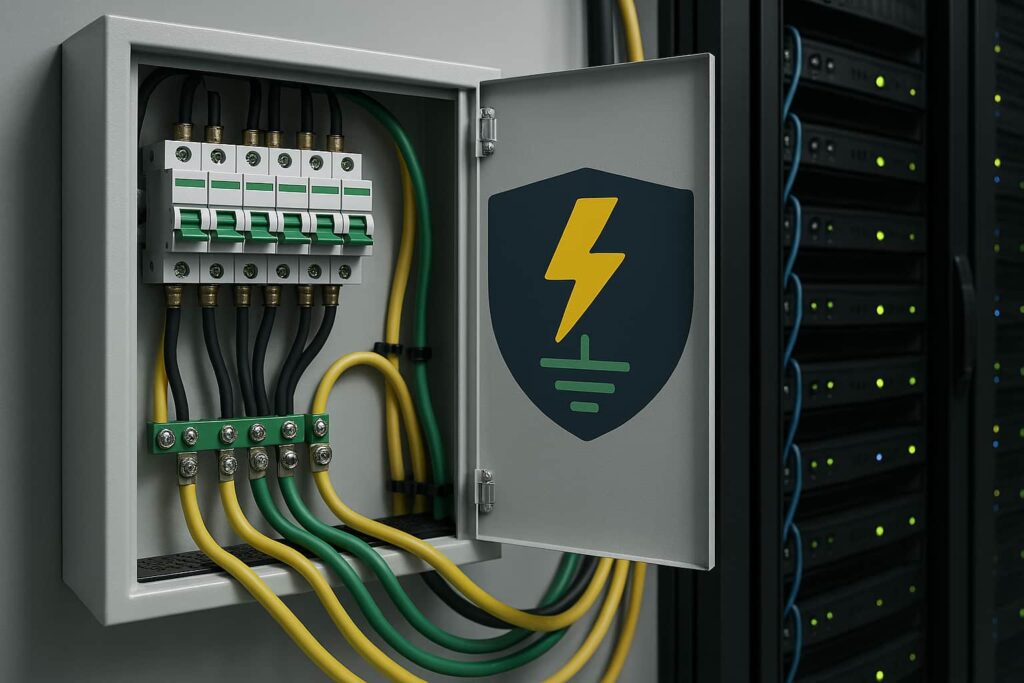
What Is the Ground in Electricity: Meaning and Function photo

Grounding is an essential concept in electricity, as it ensures safety, equipment protection, and the reliable operation of electrical systems. In home systems, the measure is used to ensure user safety and protect appliances. In server facilities and DC infrastructures, proper grounding is critical to preventing interference that can cause malfunctions in servers and network equipment. This makes the measure a foundation for reliability and efficient operation not only in everyday life but also in high-tech environments.

In the article, we’re going to discuss this issue and answer the question «What does grounding mean in electricity?».

What is the ground in electricity?

Grounding is a system that ensures the safe operation of electrical installations and protects people and equipment from electrical shock, overloads, short circuits, and other emergency situations. In engineering terminology, the measure encompasses several key aspects:

  1. Physical grounding. It is a protective measure, in which a portion of an electrical system, such as the metal housings of appliances or conductors, is connected to the ground (or a platform). The tech staff uses special electrodes, which are installed in the ground and have good conductivity (e.g., metal busbars, pipes, etc.) to accomplish this task. When a short circuit or other emergency occurs, the current flows through the conductor into the ground, which minimizes the risk of electric shock.
  2. Grounding conductors. These are electrical conductors designed to connect equipment and special electrodes (or metal parts of the system) to the ground. Conductors can have different cross-sections and be made of various materials. Still, their primary purpose is to provide a reliable and safe connection to the earth.

In everyday life, the measure is used in household electrical wiring and appliances. For instance, washing machines or refrigerators with metal housings typically have a grounding contact in the plug. This contact is connected to the special conductor. If current leaks onto the appliance housing, the current will flow to the earth through the conductor, which creates protection for people from electric shock. Thus, the measure is an important component of electrical systems, ensuring their safety and reliability.

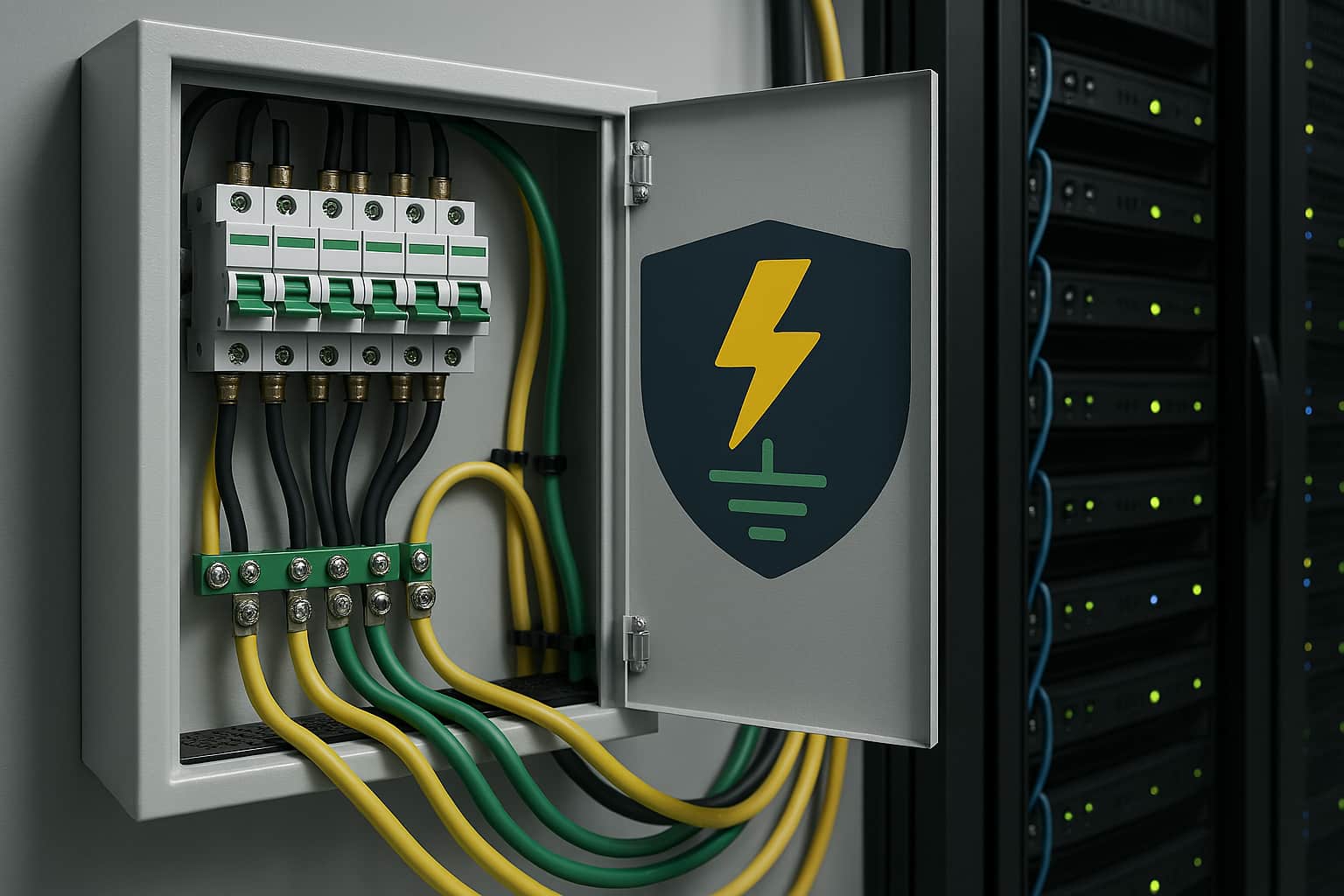
Grounding in server racks

Functions and Purpose of the Measure

Answering the question «What is the ground in electricity?» requires a deep understanding of its purpose and functions. This measure performs three vital functions:

Protection against electric shock

  1. Electric current diversion to ground. If a short circuit or current leakage occurs, a grounding device provides a low-impedance path, through which the current can safely flow to the ground. This prevents the risk of current flowing through a person who might come into contact with equipment.
  2. Surface voltage reduction. If a household appliance becomes energized due to a fault, the measure helps reduce the surface voltage of the device, which reduces the risk of electric shock upon contact.
  3. Setting the protective tripping force. The measure ensures the operation of protective devices such as circuit breakers and residual-current devices (RCDs), which disconnect the power supply when a current leak is detected.

Voltage stabilization

  1. Phase balancing. The measure helps equalize the voltage differences between phases in three-phase systems, which improves the performance and stability of the network.
  2. Grounding. It establishes a “zero” potential voltage level, which reduces fluctuations and noise in electrical systems and helps maintain stable equipment operation.

Equipment Protection

  1. Surge protection. The measure helps dissipate excess voltages caused by lightning or transients (such as when turning large loads on or off). This reduces the risk of damage to electrical components.
  2. Electromagnetic interference immunity. Reliable grounding reduces the effects of electromagnetic interference and static charges, which ensures the proper operation of sensitive equipment.

Grounding Standards

There are numerous international and national standards governing requirements, including:

International Standards

  • IEC 60364 (International Electromechanical Standard for Electric Power Supply and Distribution);
  • ISO 14001 (Environmental Management Systems Standard).

National Standards

In the US, The National Electrical Code (NEC) defines requirements in electrical systems.

The measure is often considered an essential safety requirement, and failure to comply with it can have serious consequences for both people and equipment. For this reason, proper design, installation, and regular maintenance of grounding systems are essential.

How the Measure Works in Practice

Another important aspect regarding the question of what does grounding do in electricity is the mechanism of its operation. Here, you should realize the following concepts:

  1. Current diversion. The measure serves to drain excess current into the earth. This can be accomplished using special conductors connected to metal rods driven into the ground.
  2. Grounding rods. These are metal tubes or rods installed vertically in the ground. Their purpose is to create conductivity with the ground, allowing the electrical current to be drained in the event of an emergency, such as a short circuit.
  3. Wires and potential bonding. Wires connect rods to electrical devices and systems. They provide a ground potential, thereby equalizing the electrical fields between the equipment and the earth.

In home systems, outlets often have contacts connected to special wires. This provides protection against electric shock from appliance malfunctions. In industrial facilities, the measure is often used to prevent potential short circuits. For example, equipment operating with high voltages has special systems to direct excess current to the ground. In data centers and server rooms, the measure is critical. It prevents server failures due to electromagnetic interference and power surges. All server racks are connected to a grounding bus, ensuring stable equipment operation and protection from static discharge.

The measure plays a key role in ensuring the safety and reliability of electrical systems in a wide range of applications, from household networks to high-tech data centers. It serves as an important safety mechanism that helps prevent electric shock, minimizes the risk of fire, and ensures the stable operation of devices.

To share
Comment
Previous news

The Latest Posts

What Is the Ground in Electricity: Meaning and Function

What Is the Ground in Electricity: Meaning and Function

Grounding is an essential concept in electricity, as it ensures safety, equipmen...

Read more 29/12/2025

4U vs 6U Rack Units: How to Choose the Right Format

4U vs 6U Rack Units: How to Choose the Right Format

A rack unit (U) is one of the key dimensions in the telecom industry. The parame...
Read more 24/12/2025
How to Mount Server in Rack: Installation Tips

How to Mount Server in Rack: Installation Tips

Servers come as indispensable elements of a network infrastructure. They serve a...

Read more 15/10/2025
View all
What Is the Ground in Electricity: Meaning and Function photo
+1 (438) 978-6417
info@sysracks.ca

804 Rue Deslauriers,
Montreal, H4N 1X1, Canada

Mon-Fri: 10am — 5pm

  • Server Racks
  • Accessories
  • About Us
    • Blog
    • FAQ
    • Contact Us
    • Shipping Options
      • Returns and Exchanges
      • Warranty
      • Terms and Conditions
      • Privacy Policy

      Be the first to know about new product announcements, news, events, and more

      this is pypal
      What Is the Ground in Electricity: Meaning and Function photo
      What Is the Ground in Electricity: Meaning and Function photo
      What Is the Ground in Electricity: Meaning and Function photo

      2025 © Sysracks.ca. All Rights Reserved.

      Select your currency
      CAD Canadian dollar